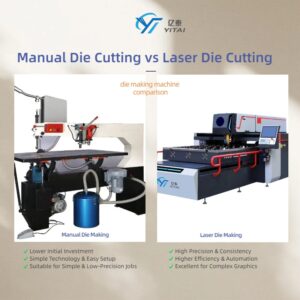
Manual Die Cutting vs Laser Die Cutting

Manual Die Cutting vs Laser Die Cutting

Manual Die Cutting vs Laser Die Cutting 12 Frequently Asked Questions Die-making Manufacturers Ask Before Upgrading In die-making production, many factory owners search online with questions like: If you are considering equipment upgrades, this FAQ guide will help you understand the key differences from a practical production perspective. Essential Products for Manual Die-Cutting Factories Q1: What is manual die cutting? Manual die cutting (also called sawing machine die processing) uses: It is a traditional mechanical method for cutting die boards. This process relies heavily on operator experience and manual precision. Manual Die-Cutting Equipment for Rotary Die Shop Q2: What is laser die cutting? Laser die cutting uses: It is a non-contact, high-precision digital process that replaces manual sawing with laser ablation. Q3: Which method is more accurate? Laser die cutting is significantly more precise. For complex die boards or high-precision packaging, laser cutting provides much better repeatability. Q4: Is laser
Read More »
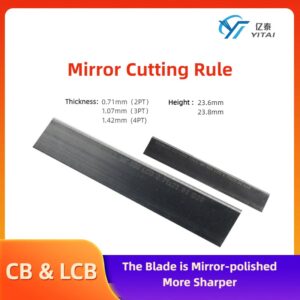
Mirror Cutting Rule

Mirror Cutting Rule

High-Precision Steel Rule for Clean & Burr-Free Die-Cutting In precision die-cutting applications, cutting quality directly determines product appearance and production stability.The Mirror Cutting Rule is specially developed for industries that require ultra-clean cut edges, minimal friction, and high dimensional accuracy. Through advanced mirror polishing technology, the cutting edge achieves superior sharpness and smoothness, making it ideal for high-end and delicate material processing. Specifications Parameter Specification Thickness 0.71 mm (2PT) / 1.07 mm (3PT) / 1.42 mm (4PT) Height 23.6 mm / 23.8 mm Edge Angle 42° / 52° Edge Hardness HS76 / HS80 Body Hardness HS48 / HS50 / HS52 Key Features Mirror-Polished Cutting Edge The blade edge is processed with precision mirror grinding technology, resulting in: This significantly improves cut quality, especially for coated or laminated materials. Lower Friction & Enhanced Surface Finish Due to the ultra-smooth blade surface: This is particularly beneficial when processing sensitive films and high-value

Read More »
Difference Between CNC Router & Laser Cutting Machine

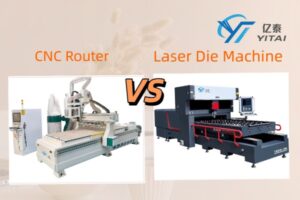
CNC Router vs. Laser Cutting Machine

Which One Is Right for Your Plywood Processing Business? When investing in new equipment, many manufacturers ask: “Both CNC routers and laser cutting machines can cut boards — what’s the real difference, and which one should we choose?” This is a critical decision. Although both machines are used for cutting, their working principles, suitable materials, cost structures, and production roles are completely different. Choosing the wrong machine can lead to wasted investment, low productivity, or unnecessary operating costs. Below, we answer the most common customer questions to help you choose the right equipment based on real production needs. Q1: What Is the Fundamental Difference Between a CNC Router and a Laser Cutting Machine? The essential difference lies in the cutting method. CNC Router A CNC router uses a high-speed rotating cutting tool or saw blade to mechanically remove material.This is a contact cutting process with strong mechanical force and stable

Read More »
cigarette packaging cutting die

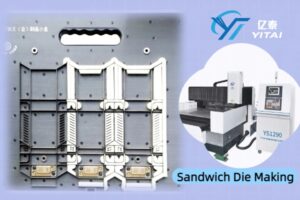
Manufacturing Process of Sandwich Cutting Dies for Cigarette Packaging

In high-end cigarette packaging, dimensional accuracy, cutting consistency, and long-term stability are non-negotiable requirements. Even minimal deviations can affect carton appearance, machine efficiency, and brand presentation. For this reason, sandwich cutting dies—also known as laminated cutting dies—have become the industry standard for premium cigarette cartons, especially in high-speed, large-volume production environments. Based on practical manufacturing experience, this article explains the structure, material selection, and key manufacturing steps of sandwich cutting dies used in cigarette packaging applications. What Is a Sandwich Cutting Die? A sandwich cutting die adopts a multi-layer laminated structure, typically consisting of: This layered construction forms a rigid “sandwich” system that significantly outperforms conventional single-layer wooden dies in terms of structural stability and dimensional control. Key Advantages for Cigarette Packaging These characteristics make sandwich cutting dies particularly suitable for complex cigarette cartons, foil-laminated boards, and premium printing finishes. Step 1: Structural Design and Engineering The manufacturing process begins

Read More »
Die-Cutting Forms Factory Direct

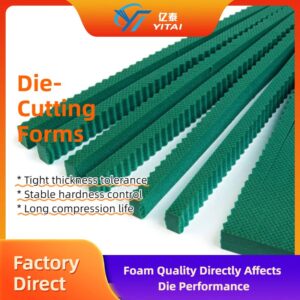
Why Die-Cutting Foams That Look the Same Perform—and Cost—Very Differently

A Technical Guide for Packaging & Die-Making Professionals In die-cutting operations, stripping foam is a functional component, not a commodity. Although many die-cutting foams appear similar in color, shape, and nominal specifications, experienced die makers know that performance differences become clear once the die enters production. The price gap is rarely visual—it is technical, and it is primarily driven by tolerance control. This article explains what professional buyers, engineers, and production managers should evaluate when selecting die-cutting foam—and why higher-quality foam often delivers a lower total cost of ownership. Industry Perspective: Why Foam Quality Directly Affects Die Performance In high-speed flatbed and rotary die-cutting, stripping foam must perform three critical functions consistently: Foam that fails in any of these areas leads to downtime, rework, and premature die failure—costs that far exceed the initial material price. 1. Raw Material Quality Defines Long-Term Rebound Behavior From a materials engineering standpoint, foam performance

Read More »
2pt 3pt 4pt Die Cutting Blade

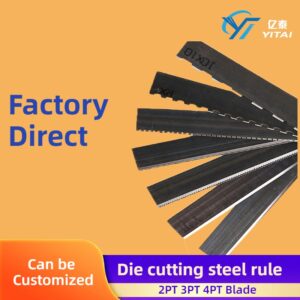
Complete Guide to Major Flatbed Die-Cutting Rule Brands: Models, Performance & Selection

Choosing the right flatbed die-cutting rule is essential for achieving clean cuts, maintaining die life, and maximizing production efficiency. With several leading brands in the market, each offering specialized models for different applications, selecting the best rule can be challenging. This guide provides a detailed comparison of top international die-cutting rule brands, explains key technical features, and offers practical recommendations to help you make an informed choice for your specific die-cutting needs. Comparison of Leading Die-Cutting Rule Brands Below is a detailed overview of major brands, their popular models, specifications, and ideal use cases. Brand (Origin) Model Bevel Type Thickness (mm) Height (mm) Hardness (HRC) Key Features Recommended Applications BOHLER (Germany) Universal Center Bevel (CB) 0.71 / 1.05 / 1.42 22.85 / 23.80 50–52 High hardness, long service life, versatile Greyboard, cardboard, high-speed cutting Masterstrip Side Bevel (SB) 0.71 / 1.07 23.30 / 23.80 54–56 Ultra-precision, sharp edge Electronics packaging,

Read More »
Die Cutting Steel Rules

Performance of Die Steel Rule on Different Materials

LCB vs CB Steel Rule Die Cutting Blades In steel rule die cutting, selecting the right die cutting steel rule is critical to achieve clean edges, stable cutting, and long tool life. Among all die cutting blades, LCB (Long Center Bevel) and CB (Center Bevel) are the two most commonly used profiles, each designed for different materials and cutting requirements. 1. LCB Die Steel Rule (Long Center Bevel) Suitable Materials Cutting Performance Limitations Typical Applications 2. CB Die Cutting Steel Rule (Center Bevel) Suitable Materials Cutting Performance Limitations Typical Applications Summary Comparison Material Type Recommended Steel Rule Die Blade Cutting Result Thin paper / film LCB die steel rule Sharp, smooth, high-precision Carton board LCB steel rule die cutting Clean edges, minimal pressure Thick board CB die cutting steel rule Stable, durable, strong impact resistance Corrugated board CB steel rule die blades Reliable and long-lasting Expert Recommendation from a Steel

Read More »
Check the Quality of Rotary Die Boards

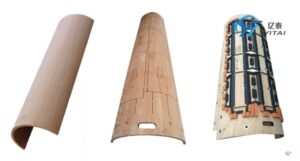
Rotary Die Board Quality Check in 5 Steps

When manufacturing rotary dies, the quality of the rotary die board (rotary shell) plays a critical role in cutting accuracy, machine stability, and tool lifespan. Poor-quality shells can lead to uneven cutting, vibration, and increased wear on laser or die-cutting equipment. Below is a simple 5-step inspection guide to help you quickly and accurately distinguish high-quality rotary die boards from inferior ones. Step 1: Inspect the Surface Carefully check the outer surface of the rotary shell for wormholes, scars, cracks, or defects. A clean and uniform surface indicates good raw material selection and proper processing. Step 2: Measure the Thickness Use a caliper to measure the shell thickness at multiple points. Inconsistent thickness often leads to cutting deviation during production. Step 3: Check Bottom & Middle Diameters Measure the diameters at both ends and the middle of the rotary shell. This tolerance ensures the shell fits properly onto the rotary

Read More »
Cross Table Laser Cutting Machine

Best Die Board Laser Cutting Machine | China Laser Cutting Die Machine Factory

Reinvent Your Die-Making Workflow with the Best Die Board Laser Cutting Machine   In the modern die-making industry, manufacturers are pushing for greater precision, shorter production cycles, and more flexible design capability. Traditional machining tools and physical blades often slow your workflow, restrict creativity, and increase operational costs. This is why many professional die shops are turning to the laser cutting die machine—a smarter technology upgrade that transforms production from start to finish. As a leading China die board laser cutting machine factory, YITAI delivers advanced solutions designed to help you achieve cleaner cuts, faster output, and more innovative designs across every project. Why Modern Die Shops Choose Laser Technology 1. Master Difficult Patterns with Ease The die board laser cutting machine China uses a high-precision laser beam to reproduce even the most detailed and complex contours. Unlike traditional blades, there is: No tool wear No mechanical limitations No need

Read More »

YITAI's Services Always Go Extra Mile

1 to 1 consulting service, hand in hand to creat brilliance, our products have been exported to North America,South Asia,Australia,South America,Africa and other regions and we also have many distributors and partners in overseas

We are here to help you !

Tell Us your needs, provide the drawings or share your idea with your requirements. Our experts will give you a reply within 24 hours

Contact to Quote

Our team of experts is ready to assist you with everything from product inquiries to technical support.