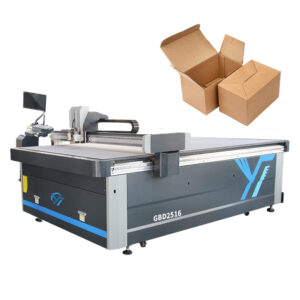
If you’ve ever handed a die board sample to a customer and watched the corners not quite line up when it’s folded, you already know the real cost of an unstable sample-making machine. It’s not just a wasted sheet of board — it’s a customer questioning whether your structural design is correct, when the actual problem was the machine, not the design.
For packaging manufacturers and structural designers, a sample-making machine isn’t a one-off tool. It runs constantly — new structures, revisions, client approvals, internal testing — often dozens of times a week. The question that actually matters isn’t “how precise is this machine on day one,” it’s “how precise is it after a year of daily use?”
Why Precision Drifts on Cheaper Machines
Most sample-making machines look fine when they’re new. The problem shows up later, and it usually traces back to three things:
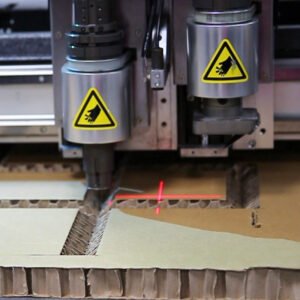
1. Linear rail quality. Budget linear rails wear unevenly under repeated high-speed motion. Over months of daily cutting, that wear translates directly into diagonal misalignment — the sample looks fine on the screen but doesn’t fold square.
2. Transmission method. Belt-driven systems are common because they’re cheap, but belts stretch over time, and that stretch is exactly what causes repeat positioning to drift. A rack-and-pinion transmission doesn’t have this problem — it maintains consistent positioning accuracy because there’s no elastic material in the drive path to stretch or slip.
3. Table flatness and rigidity. If the worktable itself isn’t dimensionally stable, even a perfectly positioned cutting head will produce inconsistent results across the sheet — tighter tolerances in the center, looser toward the edges.
None of these show up in a spec sheet for a brand-new machine. They only show up after real, sustained use — which is exactly when packaging manufacturers need the machine to still be accurate.
What We Build Differently
Rather than chase a headline precision number that only holds true on day one, the focus is on components that hold their accuracy over years of continuous use:
- HIWIN linear rails — a globally recognized standard in precision motion components, chosen specifically because of how well they maintain positioning accuracy under sustained, repeated use rather than just out-of-the-box.
- Rack-and-pinion transmission — inherently more resistant to long-term positioning drift than belt-driven systems, which matters most on high-frequency sample production.
- Honeycomb integrated worktable in Mg-Al alloy, holding a flatness tolerance of ±0.15mm, with independent partition control and 8-level vacuum suction — meaning the board stays fully seated and stable across the entire cutting area, not just near the center, regardless of sample size or shape.
- Solid overall machine construction, built to resist the frame flex and vibration that gradually throws off precision on lighter-built machines.
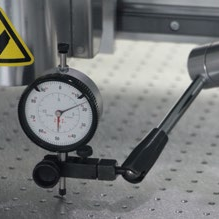
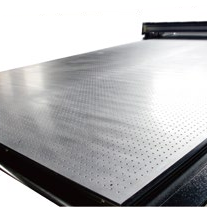
The combination is straightforward: rails that don’t wear unevenly, a transmission that doesn’t stretch, and a table that holds the board perfectly flat and secure — so the diagonal accuracy you get on sample NO.1 is the same accuracy you get on sample NO.1,000.
What This Means for Packaging Manufacturers
For die board and packaging sample production specifically, this translates into a few concrete advantages:
- Fewer rejected samples — corners and diagonals that actually align on the first cut, not the second or third attempt
- Consistency between sample and production — a sample that’s accurate today is still accurate the same way six months from now, which matters when you’re using it to validate structural designs before committing to a production run
- Lower long-term cost per sample — less wasted board material, less rework time, fewer client disputes over “the sample didn’t match what was agreed”
A Quick Way to Evaluate Any Sample-Making Machine
Whether you’re evaluating our equipment or comparing options, it’s worth asking suppliers three questions that go beyond the spec sheet:
- What brand and type of linear rail is used, and how does it perform after a year of continuous operation — not just out of the box?
- Is the transmission belt-driven or rack-and-pinion? Belt-driven systems are more prone to positioning drift over time.
- What’s the worktable’s flatness tolerance, and does it use partitioned vacuum suction to keep boards fully secured across the full cutting area?
These three answers tell you more about long-term accuracy than any single “precision” number a spec sheet can offer.