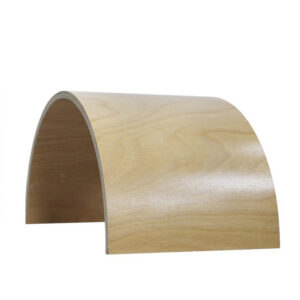
Quick answer: When sourcing rotary plywood for die-cutting, the highest-risk mistake isn’t overpaying — it’s receiving a board that doesn’t match your machine, your cutting frequency, or your climate conditions. The five factors that determine whether a board performs are: wood construction (Full Beech vs. Half Beech), density and hardness, moisture content stability, diameter tolerance, and batch-to-batch consistency.
Most buyers already know the diameter they need. What separates a good purchase from a costly one is everything behind that number.
1. Full Beech or Half Beech? Know Exactly What You’re Buying
This is the single most overlooked question in rotary plywood sourcing — and the one most likely to cause problems six months into production.
Not every factory has the capability to produce Full Beech rotary plywood. Some suppliers use a Half Beech construction but sell it simply as “Beech Plywood,” without specifying the actual layup.
So the question buyers should ask isn’t:
❌ “Is it Beech?”
It’s:
✅ “Is it Full Beech or Half Beech — and what is the actual wood construction?”
This distinction matters more than most buyers realize, because “Half Beech” is not a single, fixed material. Two boards can carry the same label and be built completely differently:
| Label | Possible Construction | Result |
| Half Beech | Beech + Birch | Balanced hardness, moderate weight |
| Half Beech | Beech + other mixed hardwoods | Variable hardness, inconsistent performance |
The name on the spec sheet may be identical. The board inside the crate may not be.
This directly affects:
- Weight
- Hardness
- Dimensional stability
- CNC machining speed
- Service life under repeated die-cutting cycles
At Yitai, our rotary die board line is built on two clearly defined constructions — Full Beech Plywood and Half Beech Plywood (Beech + Birch) — so what’s on the spec sheet is what’s in the board, batch after batch.
2. Why Full Beech Rotary Plywood Is Heavier — and What That Means for Your Machine
For the same specification (diameter, thickness), Full Beech is noticeably heavier than Half Beech. The reason is straightforward: beech has a higher density, which produces a harder board.
This has one direct, practical consequence: CNC machining resistance is higher for Full Beech, which means cutting speed during die board processing typically cannot match the speed achievable with standard Half Beech.
That is not a defect. It’s a reflection of hardness — and hardness is exactly what makes Full Beech valuable in the right application.
Full Beech offers a clear advantage for:
- High-speed, fully automatic die-cutting machines
- High-volume die-cutting production
- Operations that reuse the same board repeatedly across long production runs
So the right question isn’t:
“Which board is better?”
It’s:
“Which board is better suited to my machine and my cutting frequency?”
A board optimized for occasional, lower-volume cutting doesn’t need to carry the weight and cost of Full Beech. A board running continuously on a high-speed automatic press will wear out a lower-density board faster — and that cost shows up later, in reorders and downtime, not on the original invoice.
3. Moisture Content: Not “As Low As Possible” — “Stable and Measurable”
Buyers frequently focus on wood species and thickness while overlooking a factor that has just as much impact on long-term performance: moisture content.
From production, to packaging, to ocean freight, to warehouse storage, to final arrival at a customer’s factory, rotary plywood passes through a wide range of temperature and humidity conditions. If moisture content isn’t properly controlled at the source, the board can develop dimensional changes, warping, or reduced stability well after it has already passed initial inspection.
Before purchasing, it’s worth confirming three specific points with any supplier:
- What is the moisture content standard? (For reference, Yitai’s rotary die boards are controlled within an 8–12% range.)
- How is moisture content inspected before shipment?
- Is it consistent from batch to batch — or does it drift over time?
The goal isn’t chasing the lowest possible number. A board that’s too dry can become brittle; a board that’s too wet will move after arrival. What matters is a range that is reasonable, stable, and verifiable — not a marketing figure.
The Sourcing Checklist
Before placing a rotary plywood order, confirm the following with your supplier:
- Full Beech or Half Beech — and the exact wood construction (e.g., Beech + Birch)
- Density/hardness suited to your machine speed and cutting volume
- Moisture content standard, inspection method, and batch consistency
- Diameter and thickness tolerance range (not just nominal spec)
- Batch-to-batch consistency — does the supplier manufacture in-house, or resell mixed-source material?
About Yitai’s Rotary Die Board Line
Yitai Packaging manufactures rotary die boards under two defined constructions:
- Full Beech Plywood — higher density, built for high-speed automatic die-cutting and repeated, high-volume reuse
- Half Beech Plywood (Beech + Birch) — a defined, consistent layup, not a variable mixed-hardwood substitute sold under the same name
Both are produced with controlled moisture content and consistent tolerance across batches, so what a customer specifies is what arrives — this order and the next one. Have a specific machine speed, cutting volume, or climate condition in mind? Contact our team with your specification, and we’ll recommend the construction that fits your actual production setup — not just your diameter.