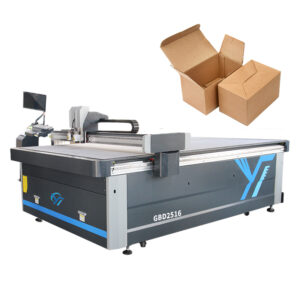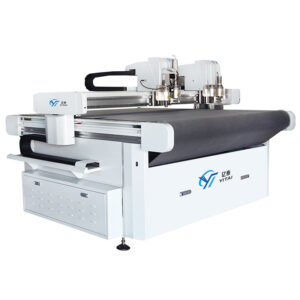
Short answer: A digital cutting table ( sample cutting table ) suits Indian corrugated converters when they need box samples, short runs and frequent design changes without paying for a die each time. Corrugated board is the first material most buyers ask about, honeycomb board is the second, and PP sheet and rigid cardboard are smaller but real needs. Before buying, check the machine against your actual material, thickness and daily workload, and ask for a test cut.
Key takeaways
- At IndiaCorr Expo 2026 in Mumbai, most visitors at our booth asked about corrugated board first. Honeycomb board came second. A smaller group asked about PP sheet and rigid cardboard boxes.
- The common thread is short lead time and many variants, not one very large run.
- A digital cutting table replaces a die for samples and small orders. It does not replace a die or a rotary press for high-volume production.
- The right questions are about **material, thickness, tools and test cuts**, not only machine price.
Who is asking, and why
India’s corrugated converting sector is made up of many small and mid-sized firms, many serving their own state or region, according to a Rabobank analysis of the industry. These converters supply food and beverage packaging, retail and e-commerce shipping boxes, and industrial packaging.
For a converter like this, a digital cutting table answers practical problems:
| Situation | The problem | What a digital cutting table changes |
| A brand owner asks for a sample box | A die takes time and money before the customer has approved the design | The sample is cut directly from the design file |
| The customer revises the layout | Each revision means a new or modified die | The file is edited and the sample is cut again |
| A small order arrives with many variants | A die per variant is rarely worth it | Small batches are cut without tooling |
| A new material is being tested | Trial runs waste board and press time | Material is tested at the table first |
What they want to cut: the demand ladder
The materials Indian buyers ask about, in the order we heard them at the show:
| Priority | Material | Typical use | What the buyer wants to know |
| 1 | Corrugated board | Shipping boxes, retail boxes, sample boxes, inserts | Which flutes and board grades are supported, how fast the table cuts, and whether creasing is clean |
| 2 | Honeycomb board | Displays, partitions, protective packaging, pallets and lightweight panels | Maximum thickness, edge quality, and which tool is needed |
| 3 | PP sheet (hollow plastic board) | Reusable boxes, trays, dividers | Whether the same table can cut it with a different tool |
| 3 | Rigid cardboard | Gift and premium boxes, sample presentation boxes | Whether the table handles the thickness and creases cleanly |
This ordering reflects what visitors asked us at one trade show. It is a useful signal, not a measurement of the whole Indian market.
Corrugated board: what buyers care about
Corrugated is the core of the Indian converting industry, and IndiaCorr itself focuses on the corrugated and folding carton industry. Buyers who cut corrugated on a digital table usually ask about:
- Board grades and flutes the machine can cut.
- Cutting and creasing quality, because a box must fold cleanly.
- Speed, because samples are time sensitive.
- Table size, so full sheets or large boxes fit.
- Software and file formats, so existing design files can be used.
Honeycomb board: what changes
Honeycomb board is thicker and has an open core, so it puts more demand on the tool and the hold-down than corrugated does. Before cutting honeycomb on any digital table, confirm:
- the maximum thickness the machine and tool can cut cleanly,
- the tool type required,
- how the board is held in place while cutting,
- the edge quality you need.
For thick or unusual honeycomb, ask for a test cut on your own board rather than relying on a specification sheet.
PP sheet and rigid cardboard
PP sheet and rigid cardboard are smaller needs for most converters we spoke to. Both are usually handled by changing the tool and adjusting settings. Confirm the supported thickness and the available tools for each material, and test both before committing.
Why now: what drives demand
Analysts have pointed to several factors behind packaging demand in India, including the growth of e-commerce, the shift from loose to packaged goods, and regulation aimed at single-use plastics that could favor paper-based packaging (Rabobank, 2019). These forecasts are several years old, and current figures should be checked against recent industry reports before you rely on them.
What this means in practice for a converter is more small orders, more design variants and more pressure on lead time. Those are the conditions where cutting without tooling is useful.
When a digital cutting table is not the right tool
A cutting table is not the best choice when:
- you run large volumes of the same box where a die and a high-speed press are far more productive,
- your daily output is mostly one standard size and style,
- you have no one to operate and maintain the machine.
In those cases, tooling usually remains more economical. Many converters use both: a digital table for samples and small orders, and dies for production.
Frequently asked questions
Yes, corrugated board is the most common material for digital cutting tables. Check the board grades, flutes and thickness range for your specific machine.
Often, with the right tool, but thickness and edge quality depend on the machine, the tool and the board. Ask for a test cut on your own honeycomb board.
Usually with a different tool and settings. Confirm the supported thickness and tool options for PP sheet before buying.
No. It replaces dies for samples, prototypes and small orders. High-volume production still usually runs on dies.
Your design file, the material you want to cut, its thickness, and the quantity you expect.
Corrugated converters, packaging sample makers and display makers who need short lead times and frequent design changes.