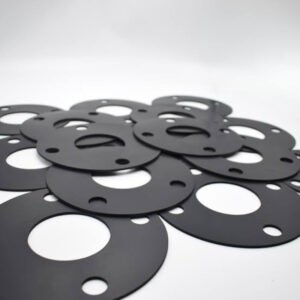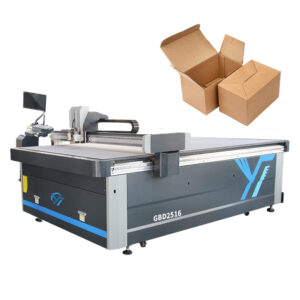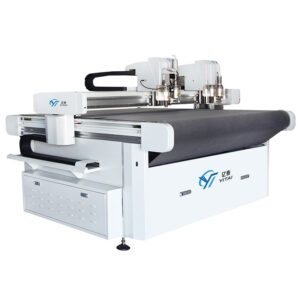
Small foam rollers, gaskets and seals are cut parts with a tiny inner hole, a small outer diameter and a soft, springy material in between. A digital cutting machine can produce these parts directly from a CAD file with no tooling, which makes it a practical way to validate a design before committing to a die. It is not always the right tool for volume production, and for very small holes the result depends on the material, so a test cut is the only reliable answer.
This guide explains why small foam parts are difficult to cut, what decides whether a small hole cuts cleanly, and how to move from prototype to production without wasting money on tooling too early.
Why Small Foam Parts Are Hard to Cut
Foam is not a rigid material. When a blade presses into it, the foam compresses, pushes sideways and then springs back. On a large part this barely matters. On a part with a hole of a few millimetres, it can be the difference between a clean hole and a distorted one.
The typical problems are:
- Hole distortion: the foam closes in around the blade, so the finished hole is smaller or less round than the drawing.
- Tapered walls: the hole is wider at one face than the other because the material deflects as the blade goes through.
- Rough or torn edges: soft, open-cell foam can tear instead of cutting cleanly.
- Part movement: small, light parts shift while being cut if they are not held firmly.
What a Digital Cutter Does Well in the Prototype Phase
When a new part is still in development, dimensions change, materials are being compared and quantities are small. This is where digital cutting fits:
- No tooling cost. A new design goes from a drawing to a physical part without waiting for a die to be made.
- Fast design changes. Changing an inner diameter or a spacing means editing a file, not remaking a tool.
- Material comparison. Several foam densities and hardnesses can be cut and compared in the same session.
- Full sheet nesting. Many parts can be laid out on a single plate and cut in one run.
For a new product line, this means the design can be proven out first, and tooling cost is only spent once the part is stable.
What Decides Whether a Small Hole Cuts Cleanly
There is no single minimum hole size that applies to every foam. The result depends on a combination of factors:
- Material thickness. The deeper the cut, the more the foam deflects. A thin sheet is much easier than a thick one at the same hole diameter.
- Hardness and density. Firmer, denser foam holds its shape better. Very soft foam is harder to cut cleanly because it compresses and rebounds.
- Hole diameter relative to the knife. A blade has a physical thickness and a limit on how tightly it can turn. As the hole gets smaller, the cutting path has less room.
- Knife type and condition. Different blades suit different materials, and a worn blade tears foam instead of slicing it.
- Hold-down. Small parts must be held firmly during cutting, through vacuum or other fixturing, or they move and the cut drifts.
- Cutting path and speed. The order of cuts and the feed speed both affect how much the foam moves.
Because these factors interact, two foams that look similar can behave very differently at the same hole size.
Why You Should Request a Test Cut
For small holes in soft material, no machine specification can guarantee the result in advance. The honest approach is to cut your actual material to your actual drawing and inspect the parts.
A test cut shows you what a datasheet cannot:
- whether the hole stays round and holds its diameter,
- whether the walls are straight or tapered,
- how clean the edge is,
- how long each part takes to cut.
Sending a sample sheet and a drawing for a trial cut is the lowest-risk way to decide whether digital cutting suits your part.
Prototype to Production: When to Move to Tooling
Digital cutting and die cutting solve different stages of the same project.
| Stage | Typical need | Better fit |
| Design validation | Few parts, frequent changes | Digital cutting |
| Pilot runs | Small batches, several variants | Digital cutting |
| Stable design, rising volume | Same part, larger quantities | Evaluate both |
| High-volume production | Very short cycle time per part | Die cutting or punching |
If a part needs to be produced in a few seconds each at large volume, tooling usually becomes more economical. Many manufacturers use both: digital cutting to develop and prove the part, then a die once the design is final.
What to Send When Requesting a Test Cut
To get a meaningful answer quickly, include:
- the drawing with inner and outer diameters and tolerances,
- the material type, density and hardness,
- the sheet thickness and sheet size,
- the expected quantity and any target cycle time,
- a small sample of the actual foam.
FAQ
Often yes, but it depends on the material thickness, hardness and the hole diameter. Because small holes in soft foam are sensitive to all three, a test cut on the actual material is the reliable way to confirm.
It is best suited to prototyping, pilot runs and small to medium batches. For high volumes with very short cycle times per part, die cutting or punching is usually more economical.
Soft foam compresses under the blade and springs back, which can close the hole or taper its walls. Firmer foam holds its shape better.
No. Digital cutting works directly from a CAD file, so you can test the design before spending on tooling.
A drawing, the material specification, sheet thickness and size, expected quantity, and ideally a physical sample of the foam.
Developing a small foam roller, gasket or seal? Send us your drawing and a material sample, and our team will run a test cut so you can judge the result before you commit to equipment or tooling.