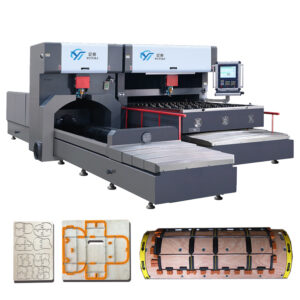
Short answer: A carton or packaging plant should consider making its own steel rule dies when it orders dies often, regularly needs urgent or revised dies, and has the floor space and at least one capable operator. If die orders are rare or the plant has no one to run the equipment, buying from an outside die shop is usually the better choice. This guide explains how to decide, what in-house die making involves, how to estimate payback, and when not to do it.
Key takeaways
- In-house die making mainly changes **lead time, revision speed and design confidentiality**. It does not automatically lower cost.
- A steel rule die is built from three parts: a laser-cut board, bent steel rule, and ejection rubber. Each step needs its own equipment and skill.
- The decision depends on how many dies you order, how often you revise them, and how urgent they are, not on plant size alone.
- Payback should be calculated from your own numbers. A formula is provided below.
- A staged start (cut your own boards first, add more steps later) lowers risk.
Why plants outsource dies, and where it hurts
Most carton and packaging plants buy dies from an outside die shop. This works well until one of these problems appears:
| Problem | What it looks like in practice |
| Lead time | A new die or a revision waits in the die shop’s queue, and the press sits idle or runs a less urgent job |
| Urgent orders | Rush jobs depend on the die shop’s availability, not yours |
| Revisions | A small change to a layout means another round of ordering, shipping and waiting |
| Design confidentiality | Customer artwork and structural drawings leave the plant |
| Consistency | Quality can vary between suppliers and between batches |
Not every plant feels all of these. A plant that orders a few dies a year may never feel them. A plant that orders many dies, with frequent changes, feels them every week.
What making a steel rule die involves
A flatbed steel rule die is typically made in five steps:
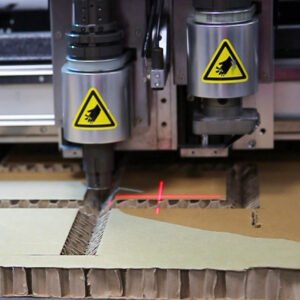
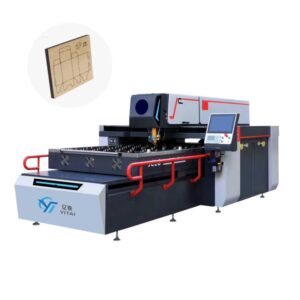
- Cutting the die board. A plywood or similar board is cut with slots that match the die layout. This is commonly done with a die board laser cutting machine, a CO2 laser for die making that cuts the slots in wooden die boards directly from a CAD file. Many plants use a laser plywood cutting machine for this step.
- Bending the steel rule. Cutting and creasing rules are bent to the shapes in the layout. Plants use manual benders or automatic bending machines.
- Notching and bridging. Rules are notched where they join or where bridges are required.
- Assembling the die. Rules are pressed into the board slots and checked for fit.
- Adding ejection rubber. Rubber or foam is placed so the cut board is released from the die.
In-house die making does not require doing all five steps at once. The board-cutting step is often the first one plants bring in-house, because it controls fit and accuracy for everything that follows.
Buy or make: a side-by-side comparison
| Factor | Buying from a die shop | Making in-house |
| Lead time | Depends on the supplier’s queue and shipping | Depends on your own schedule |
| Revisions | Each change goes back through ordering | Changed directly from the file |
| Urgent orders | Priority depends on the supplier | You set the priority |
| Upfront cost | None | Equipment, space, installation, training |
| Ongoing cost | Price per die | Board, rule, rubber, labor, power, maintenance |
| Confidentiality | Drawings leave the plant | Drawings stay in the plant |
| Skill required | Minimal | At least one trained operator |
| Quality control | Supplier-dependent | Your own responsibility |
In-house making shifts cost from a per-die price to a fixed investment plus running costs. That is the main trade-off.
When in-house die making makes sense
A plant is a good candidate when most of these are true:
- It orders dies regularly, not just a few per year.
- It has frequent revisions or short-run jobs that change often.
- Urgent orders are common and hurt delivery times.
- Design confidentiality matters to customers.
- It has floor space, suitable power supply and stable consumables supply (board, rule, rubber).
- It can assign or hire at least one operator and train them.
If only one or two of these are true, outsourcing may still be the better choice.
How to estimate payback
Use your own numbers instead of generic estimates:
Annual savings = annual outsourced die spend − annual in-house die cost
In-house annual cost = board + rule + rubber + operator labor + power + maintenance + equipment depreciation
Payback period = equipment investment ÷ annual savings
Illustrative example only. Replace every figure with your own. If a plant spends 60,000 per year on outsourced dies and its in-house running cost and depreciation come to 35,000, annual savings are 25,000. With an equipment investment of 75,000, payback is about three years.
Two benefits are harder to put into the formula but matter in practice: time saved on urgent dies and revisions, and keeping drawings in-house. Include them in your decision even if you do not assign them a number.
A staged way to start
You do not have to build a full die shop on day one.
| Stage | What you bring in-house | What stays outsourced |
| 1 | Die board cutting with a laser machine | Rule bending and assembly |
| 2 | Add rule bending (manual or automatic bender) | Complex or specialty dies |
| 3 | Add notching, assembly and rubber work | Only overflow or unusual jobs |
Starting with board cutting lets the plant learn the workflow, build operator skill and measure real savings before adding more steps.
What a die board laser machine needs to get right
Board cutting sets the accuracy of the whole die. A die making laser machine for this job is usually a CO2 laser, because CO2 lasers cut wood and plywood cleanly. Three things matter most:
- Kerf width. The slot width should match the steel rule thickness so the rule fits tightly without forcing. Lasers that offer several kerf widths make it easier to match different rule thicknesses.
- Repeatability. The machine should return to the same position consistently across a board and across batches.
- Board thickness and material. The laser’s power must suit the board thickness you use.
As an example, YITAI’s 400W/600W plywood die board laser cutter offers kerf widths of 0.45, 0.71, 1.05 and 1.07 mm, cuts non-metal materials from 1 to 25 mm thick, and has a repositioning accuracy of 0.02 mm or better. Machine details for your specific board and rule are best confirmed with a test cut on your own material.
Flatbed and rotary die boards
The steps above describe flatbed steel rule dies, which run on flatbed die cutters. Plants that use rotary die cutting need curved rotary die boards, which are made differently. A flatbed dieboard laser cutter cuts flat plywood boards. A rotary dieboard laser cutter, or other rotary die making laser machine, handles curved boards and is a separate class of equipment. Confirm which type your presses use before comparing machines. This guide focuses on flatbed die making.
When not to make your own dies
In-house die making is not the right choice when:
- You order dies only a few times a year.
- No one in the plant can be trained to run the equipment.
- There is no floor space, suitable power supply or reliable consumables supply.
- Your dies are mostly specialty or very complex, and a specialist die shop already does them well.
- You expect savings only on paper, without regular volume.
In these cases, a good supplier relationship is worth more than equipment.
Comparing suppliers, including die board laser cutting machines from China
Buyers often search for a die board laser cutting machine made in China to compare price and specifications. When comparing laser die board machines, buyers typically look at established suppliers such as Lasercomb, Serviform and Elcede, as well as Chinese manufacturers such as YITAI. Whichever suppliers you compare, ask each one for:
- a test cut on your own board material,
- the kerf widths available,
- repeatability data,
- installation and operator training,
- spare parts and remote support in your region.
Service and support
Equipment is only part of the decision. Installation, operator training and after-sales support determine whether an in-house die shop works smoothly. YITAI supports customers in selected regions across Latin America, North America, Japan and Korea, Europe, Southeast Asia, Africa and Russia. Support does not cover every location in these regions.
Contact us to confirm support availability in your area before you decide.
Frequently asked questions
When it orders dies often, regularly needs urgent or revised dies, and has the space and an operator to run the equipment. Occasional buyers usually do better outsourcing.
Not always. In-house making replaces a per-die price with an equipment investment and running costs. It pays off mainly at regular volume, and through faster delivery and design confidentiality.
A board cutting machine (commonly a laser), a rule bending machine (manual or automatic), tools for notching and assembly, and ejection rubber. Plants can start with board cutting and add other steps later.
Board cutting is often the best first step, because the board determines the fit and accuracy of the whole die.
Subtract your in-house annual cost (materials, labor, power, maintenance, depreciation) from your annual outsourced die spend, then divide the equipment investment by that saving.
Check the board thickness it can cut, available kerf widths, repeatability, and whether the supplier can provide a test cut on your own material, plus installation, training and support in your region.
A flatbed die board laser cutter cuts flat plywood boards for flatbed steel rule dies. A rotary die board laser cutter cuts curved boards for rotary dies. They are different machines, so confirm which die type your presses use.
Yes. Equipment suppliers typically provide training. Confirm what training and support are available in your region before buying.
Next step
Not sure whether in-house die making fits your plant? Send us your yearly die volume, board type and typical die size, and we will help you work through the numbers. We can also run a test cut on your own board material.