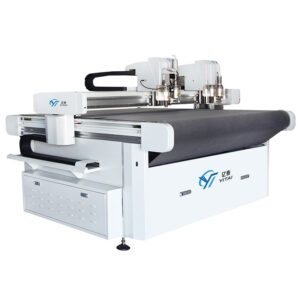
A Familiar Scenario on the Shop Floor
A batch of 15mm NBR or EPDM gaskets needs to go out on schedule. The laser cutter fills the shop with smoke and leaves scorched, discolored edges — not acceptable for a sealing application. Switching to a standard digital cutter helps with the smell, but the cut edges come out angled instead of straight, and a large share of the batch fails inspection before it even leaves the shop.
As sealing tolerances tighten — especially for buyers in high-labor-cost markets like Korea, Europe, and North America — this kind of inconsistency isn’t just a quality issue anymore. It’s becoming the reason converters lose bids to competitors running more consistent equipment.
Three Technical Problems Behind Most Thick Rubber Cutting Failures
1. The “Taper” Problem
Once rubber thickness moves past a certain point, a standard oscillating blade often can’t hold a fully vertical path through the material. Under high-speed, continuous cutting, the blade tends to flex slightly off-axis, and the result is a cut edge that leans — wider at the top, narrower at the bottom (or vice versa). For a round gasket, that means the part is subtly out-of-round in cross-section, which is exactly the kind of defect that fails a sealing test even though the part “looks fine” on the surface.
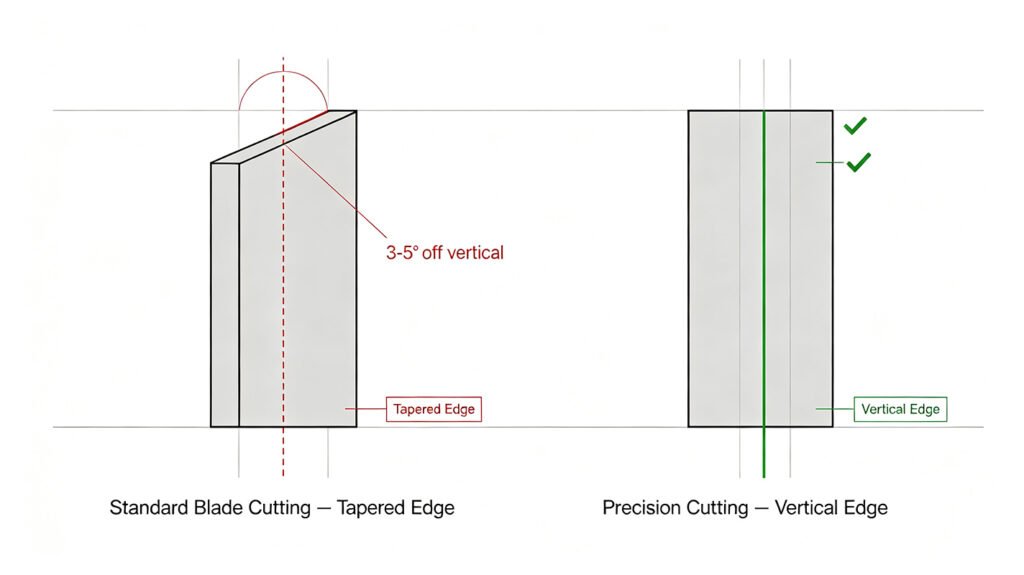
Tapered vs vertical edge rubber gasket cutting comparisonThis isn’t a question of whether a machine can physically cut through 15mm rubber. Most can. The real question is whether it can do it with a vertical, repeatable cut — batch after batch — without the edge quality drifting as the blade wears or the material varies slightly in hardness.
2. Small Holes and Sharp Corners: Where Blade Cutting Hits Its Limit
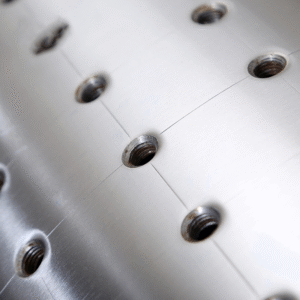
Bolt holes, small inner diameters, and sharp internal corners are common features on rubber gaskets — and they’re also where oscillating blade cutting struggles most. A blade has physical width, and when it tries to “turn” inside a very small hole, it can distort the shape or tear the edge instead of producing a clean, round cut.
This is exactly why punching — a physical, rotating punch tool — exists as a separate process from blade cutting. For bolt holes and small round features, a dedicated punching tool produces a cleaner result than trying to force a blade to do a job it isn’t well suited for.
3. The Tool-Change Bottleneck
Here’s where automation advantages tend to disappear in practice: if a gasket design has multiple bolt holes of different diameters, and the machine can only hold one tool at a time, the operator ends up stopping production repeatedly to swap tools. For continuous, high-volume production, this tool-change downtime can erase most of the efficiency gain that automation was supposed to deliver in the first place.
What Actually Solves These Problems
Each of these issues has a specific, addressable cause — which means the fix isn’t a single “better blade,” but a combination of capabilities working together:
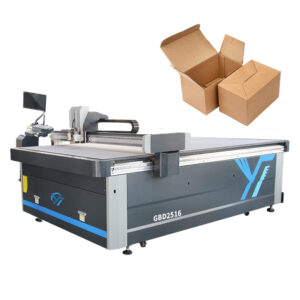
- Multi-tool-position setup — an oscillating blade, a punching tool, and a third tool station mounted and ready simultaneously, so the machine switches between cutting and punching without stopping for a manual tool change
- Precision height tracking during the cut — automatic blade height measurement and compensation that adjusts as the machine works, keeping the cut path vertical through the full thickness of thick material instead of letting the blade drift off-axis
- Zone-based vacuum hold-down — rather than a single flat suction area, vacuum concentrated specifically where the material is actively being cut, so a large sheet stays securely held even after it’s been cut into dozens of individual pieces
Together, these three capabilities directly answer the taper problem, the small-hole limitation, and the tool-change bottleneck — the three issues that account for most of the rejected parts and lost production time in thick rubber gasket cutting.
Verifying Before You Commit
For a production-critical purchase like this, taking a supplier’s word for cutting quality usually isn’t enough — and it shouldn’t be. Before committing to new equipment, it’s reasonable to expect:
- A test run using your own material and your own drawing file (DXF), not a generic sample
- Process footage showing the actual cutting and punching sequence, not just a finished part
- Measured results — edge verticality, hole diameter, and dimensional accuracy — checked with calipers or equivalent tools, not just visual inspection
A supplier confident in their equipment’s performance should have no hesitation supporting this kind of verification process.
Frequently Asked Questions
As material thickness increases, a standard blade has more opportunity to flex off its vertical path during the cut, especially at high speed. This produces an angled (“tapered”) edge rather than a straight vertical one, which can cause sealing or fit issues in the finished part.
A blade’s physical width limits how tightly it can turn, which can distort or tear very small holes. A rotating punch tool is purpose-built for round holes and produces a cleaner result for features like bolt holes.
With a multi-tool-position setup, yes — different tools can be mounted simultaneously and switched between automatically during a single job, avoiding the downtime of manual tool changes.
Working with thick rubber gaskets, bolt-hole patterns, or tight tolerance requirements? Send us your material specs and a DXF file — we’re happy to run a test cut and share the full process on video.