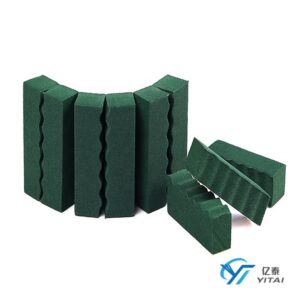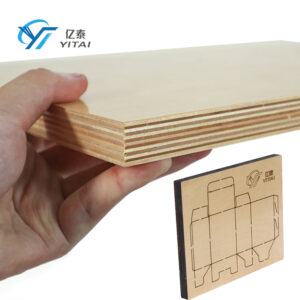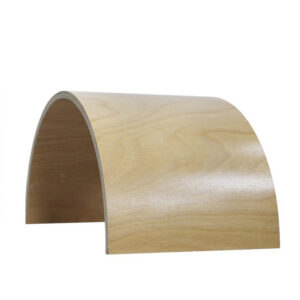
A Technical Guide for Packaging & Die-Making Professionals
In die-cutting operations, stripping foam is a functional component, not a commodity.
Although many die-cutting foams appear similar in color, shape, and nominal specifications, experienced die makers know that performance differences become clear once the die enters production. The price gap is rarely visual—it is technical, and it is primarily driven by tolerance control.
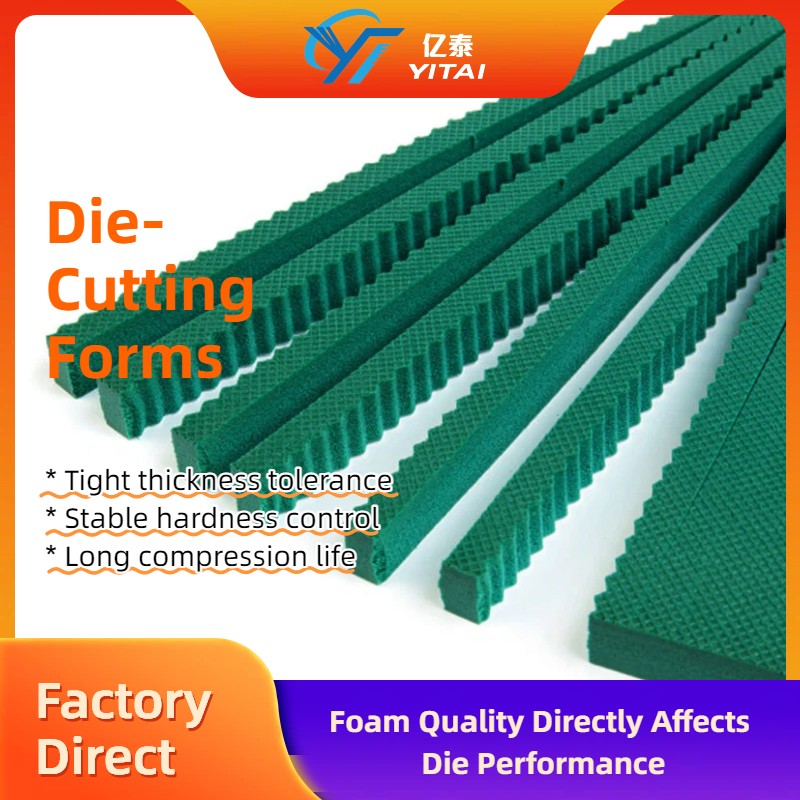
This article explains what professional buyers, engineers, and production managers should evaluate when selecting die-cutting foam—and why higher-quality foam often delivers a lower total cost of ownership.
Industry Perspective: Why Foam Quality Directly Affects Die Performance
In high-speed flatbed and rotary die-cutting, stripping foam must perform three critical functions consistently:
- Release waste cleanly
- Maintain stable rebound force over time
- Protect cutting rules and die boards from unnecessary stress
Foam that fails in any of these areas leads to downtime, rework, and premature die failure—costs that far exceed the initial material price.
1. Raw Material Quality Defines Long-Term Rebound Behavior
From a materials engineering standpoint, foam performance begins with its base formulation.
High-grade die-cutting foams use:
- High-resilience virgin polymers
- Uniform, closed or controlled cell structures
Lower-grade alternatives often rely on:
- Mixed or recycled materials
- Inconsistent cell density
While initial height may appear identical, material quality determines how the foam behaves after repeated compression cycles, which is the true performance benchmark in industrial die-cutting.
2. Thickness Tolerance: A Hidden Variable with Direct Production Impact
Thickness tolerance is one of the most underestimated factors in foam selection.
Typical industry ranges:
- Standard foam: thickness variation often ±0.5 mm or more
- Precision foam: controlled within ±0.2 mm or tighter
Operational consequences of poor thickness control include:
- Incomplete waste stripping in low-pressure zones
- Excessive compression in high-pressure zones, causing early collapse
- Repeated shimming, trial runs, and machine adjustments
From a production management perspective, tight thickness tolerance equals stable die setup and repeatable results.
3. Hardness Consistency: Stability Beyond the Specification Sheet
Hardness values alone do not define foam performance—hardness uniformity does.
- Low-cost foams often show hardness variation along the same strip
- Industrial-grade foams maintain consistent hardness across length and batches
Inconsistent hardness leads to:
- Uneven stripping force
- Imbalanced cutting pressure
- Localized fatigue and unpredictable die behavior
Professional die makers rely on foam that delivers consistent rebound force across the entire die, cycle after cycle.
4. Compression Life Reflects Manufacturing Control
Under continuous production conditions:
- Foams with wide tolerance variation fail at their weakest points
- Foams with tight thickness and hardness control age uniformly
For B2B buyers, this translates to:
- Predictable replacement cycles
- Reduced emergency downtime
- Lower long-term consumable cost
The price difference reflects effective service life, not one-time usage.
5. Batch Consistency Reduces Procurement and Quality Risk
From a purchasing and quality assurance standpoint, inconsistency is a hidden cost.
Low-price foams often result in:
- Performance variation between batches
- Difficulty matching previous orders
- Customer complaints that are difficult to trace
High-standard die-cutting foams offer:
- Repeatable specifications
- Controlled tolerances
- Stable performance across long-term supply
This level of consistency is essential for scaled packaging production and export-oriented manufacturers.
Buyer’s Conclusion: Compare Unit Price, Calculate Total Cost
Die-cutting foams may look similar—but performance differences are hidden in:
- Thickness tolerance
- Hardness tolerance
- Material stability
Professional buyers compare price at purchase.
Experienced manufacturers calculate total production cost.
The right die-cutting foam makes your die:
- More stable
- More predictable
- More profitable
About Our Die-Cutting Foam Solutions
We supply industrial-grade die-cutting and stripping foams engineered for:
- Tight thickness tolerance
- Stable hardness control
- Long compression life
Our foams are widely used in packaging, carton, corrugated, and precision die-cutting applications, supporting consistent results in both flatbed and rotary die-cutting systems.
📩 Contact our technical team for application-specific recommendations and material selection support.